
Coin
Face Value: Silver Coins in Circulation
Jan
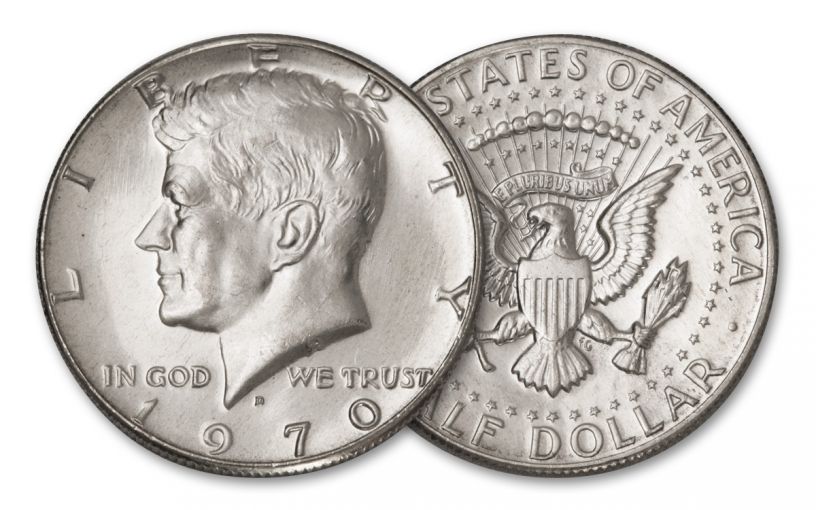
1964-1970 Kennedy Half Dollar
It has been decades since the half dollar was routinely used as circulating currency in the US. Indeed, even in 1964, the new Kennedy Half Dollars were snapped up and saved by an American public eager to commemorate the slain president. But if you do come across a Kennedy Half Dollar, it’s a good idea to check its date.
The 1964 version is 90% Silver, while the business strikes dated 1965 to 1970 are 40% Silver. (A small number of 1971-D and 1977-D Kennedy Half Dollars are known to have been mistakenly struck on silver-clad planchets, and they can sell for thousands of dollars at auction.)
The value of a 1964-1970 Kennedy Half Dollar begins with its melt value, which floats based on the price of silver. Here are some examples:
- If silver is $20 per ounce, a 1964 Kennedy Half Dollar (which is 90% silver) has a melt value of $10.85
- If silver is $20 per ounce, a 1965-1970 Kennedy Half Dollar (which is 40% silver) has a melt value of $2.96
- If silver is $30 per ounce, a 1964 Kennedy Half Dollar has a melt value of $10.85
- If silver is $30 per ounce, a 1965-1970 Kennedy Half Dollar has a melt value of $4.44
To learn more about Kennedy Half Dollars and to see the latest melt values and values from the NGC Price Guide.
Transitional Errors
Some silver coins might be hiding in circulation because they have transitional errors. These errors occur whenever a coin’s metal composition changes. Sometimes, a coin is mistakenly struck using the older planchet, or sometimes a coin is struck with a planchet intended for the following year.
For example, a Heritage Auctions sale has a 1965 Dime and a 1965 Quarter that were struck using the 90% silver planchets that were supposed to have been used only for coins dated 1964 and earlier. These coins are likely to sell for thousands of dollars, because nearly all their value comes from the fact that there are extremely rare errors.
If you think you might have a 1965 Dime or 1965 Quarter that was mistakenly struck on a 90% planchet but you don’t have access to the equipment to run a metallurgical analysis, don’t worry. You can start by weighing them: The heavier silver would make the coin weigh significantly more than it should. A coin dealer or respected online coin community could offer some advice, and third-party coin certification would remove all doubt.

